


Ayurvedic Anti-Aging Skincare: The Rasayana Approach to Skin Longevity
Ayurveda is often described as taking a holistic approach to health. In the context of skin aging, this is more than a general principle — it is a specific, structured framework with its own pharmacology, practices, and classical texts. The branch of Ayurvedic medicine most directly concerned with longevity and tissue renewal is called Rasayana — a Sanskrit term combining Rasa (the primary body fluid, the first of the seven tissue layers) and Ayana (path or movement). Rasayana is the science of sustaining and renewing the tissues, slowing their depletion, and supporting the vitality of the body over time.
What this means for skin — the body's outermost tissue layer and the most visible expression of internal health — is that classical Ayurveda does not separate "anti-aging skincare" from the broader question of how the body ages at the level of its tissues. External preparations play a role; internal practices, seasonal adjustment, and daily routine play an equal or greater one. The most effective classical approach works at both levels simultaneously.
How Classical Ayurveda Understands Skin Aging
The Ayurvedic understanding of aging centres on the concept of Dhatu Kshaya — the progressive depletion of the body's tissue layers. Classical Ayurvedic physiology describes seven Dhatus (tissue layers), each nourished sequentially by the previous one in a chain that begins with Rasa (plasma) and ends with Ojas — the refined vital essence of all tissues. When the quality and quantity of nourishment flowing through this chain is sustained, the tissues, including the skin, maintain their integrity. When it is depleted — through poor diet, inadequate sleep, chronic stress, excessive activity, or the natural process of aging — the tissues begin to show signs of Kshaya: dryness, thinning, loss of elasticity, reduced radiance.
The skin, as the outermost layer, reflects the condition of the internal tissues. In classical Ayurveda, dull, dry, or aging skin is understood not primarily as a surface problem but as an expression of what is happening deeper in the tissue chain. This is why Rasayana practices — which work at the level of Rasa Dhatu and Ojas — are considered the primary approach to skin longevity, not merely a complement to topical products.
The Rasayana guide covers the full classical framework in depth. The Ojas guide explains the concept of vital essence and its direct relationship to skin radiance and the aging process.
The Role of Vata in Skin Aging
Among the three Doshas, Vata has the most direct and consistent relationship with aging. Classical Ayurvedic texts describe the later stages of life as naturally Vata-dominant — and Vata's qualities (dry, cold, light, rough, mobile) are precisely the qualities that manifest as aged skin: dryness, fine lines, loss of elasticity, thinning of the skin layers, and a decrease in natural moisture and lustre.
This is why classical Ayurvedic skin care for aging is predominantly Vatahara in its approach: nourishing, warming, unctuous, heavy enough to counteract Vata's lightness and dryness. Classical external preparations for the face — Mukha Tailams — are almost universally sesame-based, reflecting sesame oil's inherent Vatahara, deeply penetrating qualities.
Pitta and Kapha aging present differently. Pitta-driven skin aging manifests as inflammation, hyperpigmentation, and reactive sensitivity. Kapha aging presents as congestion, enlarged pores, and reduced skin tone. Classical preparations and practices adapt accordingly. But Vata depletion is the deepest and most universal aging mechanism, and sustaining the skin's nourishment through Vatahara practice is the foundation on which everything else is built.
Classical External Preparations for Facial Care
Mukha Tailams — Medicated Face Oils
The classical category of preparations for facial use is Mukha Tailam — face oils prepared through the Sneha Paka process with herbs specifically selected for their action on facial skin, complexion, and tone. Two preparations stand out in classical texts for their specific skin-longevity applications:
Kumkumadi Tailam — the most celebrated classical face oil, built around saffron (Kumkuma, Crocus sativus) as its primary ingredient and classically containing 16 or more herbs including sandalwood, manjistha, and lotus. Classical texts reference Kumkumadi for its Varnya (complexion-enhancing) and Kanti (natural lustre-promoting) actions — the specific categories in Ayurvedic pharmacology most associated with skin radiance and the preservation of complexion quality over time. The complete Kumkumadi guide covers the classical formula, herbs, and method of use in detail.
Eladi Tailam — a classical preparation built on cardamom (Ela) with a combination of cooling, Pitta-balancing herbs including vetiver and sandalwood. Where Kumkumadi is primarily Varnya and Rasayana in its classical action, Eladi is more specifically cooling and Pitta-balancing — appropriate for reactive, sensitive, or Pitta-driven skin patterns. For those with both Vata aging and Pitta reactivity, alternating or combining these two preparations is a classical approach.
Ubtan — Classical Face Powders
The Ubtan tradition — applying carefully formulated herb and grain powders to the face as a cleansing, brightening, and skin-nourishing treatment — is one of the oldest documented forms of Ayurvedic skincare, described in the Charaka Samhita and Ashtanga Hridayam. Classical Ubtan formulas combine Varnya herbs (chickpea flour, sandalwood, turmeric, manjistha) with oil or milk as a binding medium, producing preparations that simultaneously cleanse and deliver herb properties at the skin's surface. Regular use of Ubtan in place of soap-based cleansing is one of the classical approaches to sustaining the skin's natural protective barrier while maintaining cleanliness.
The Kansa Wand in Anti-Aging Practice
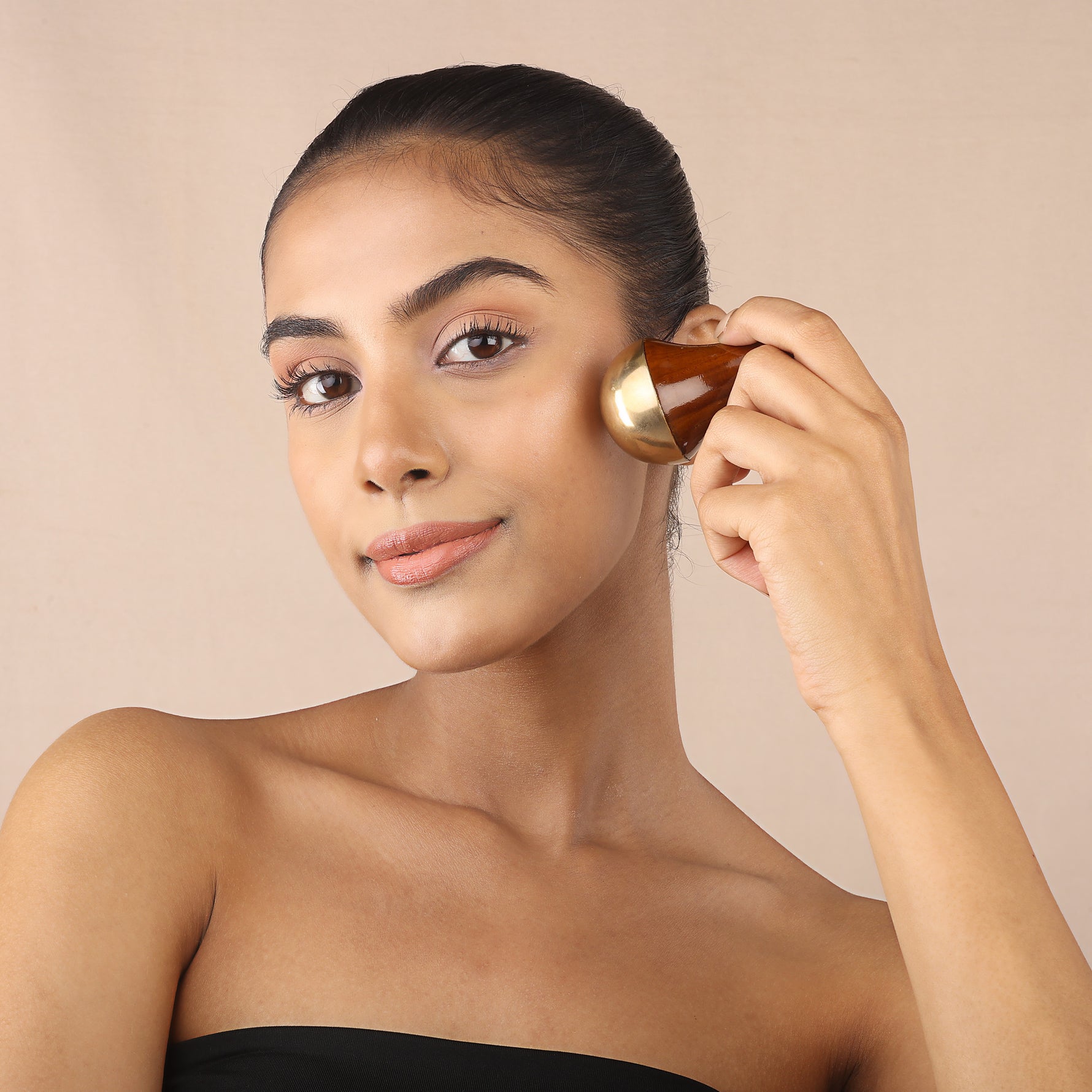
The Kansa wand occupies a specific place in classical Ayurvedic facial care — not as a topical preparation but as a practice tool working through the properties of the classical alloy and through its action on the facial marma points.
The marma points — classical vital junctions concentrated on the face at points including Sthapani (between the eyebrows), Apanga (outer eye corners), Shankha (temples), and Hanu (jaw) — are described in classical Ayurvedic anatomy as junctions where life force (Prana) and body tissue (Dhatu) meet. Rhythmic stimulation of these points through Kansa massage supports local lymphatic circulation and the flow of Prana through the facial tissues — a distinctly different action from physical massage alone.
The alloy's natural Pitta-balancing effect — drawing surface heat and acidity from the skin through the electrochemical reaction that produces the characteristic grey residue — addresses one of the key contributors to accelerated facial aging in many constitutions: chronic low-grade inflammation. This residue typically diminishes with regular practice as Pitta is progressively balanced.
The Kansa wand face massage guide covers the full technique: movement sequence, pressure, duration, and which face oils complement the practice best.
Internal Practices: The Foundation of Skin Longevity
The most distinctive aspect of the classical Ayurvedic approach to skin aging — and the aspect most absent from modern "Ayurvedic skincare" marketing — is the emphasis on internal practices. Classical texts are unambiguous: the condition of the skin is primarily determined by the quality of the internal tissues and the vitality of Ojas.
Ojas — the refined essence of all seven tissue layers — is what gives the skin its natural lustre, the eyes their clarity, and the entire body its sense of vitality. Classical Ojas-building practices are central to any serious Rasayana approach to skin longevity:
Daily Abhyanga. Daily warm oil self-massage with a classical Vatahara Tailam is described in the Ashtanga Hridayam as one of the primary practices for sustaining skin health and tissue nourishment over time. The warming, penetrating quality of sesame-based Tailams counteracts Vata's drying action on the tissues, while the physical practice stimulates lymphatic and peripheral circulation in the skin. The Abhyanga guide covers the full practice.
Consistent sleep. Classical texts list Nidra (sleep) as one of the three pillars of health. Inadequate sleep is described as a primary cause of Ojas depletion — which manifests first and most visibly in the skin.
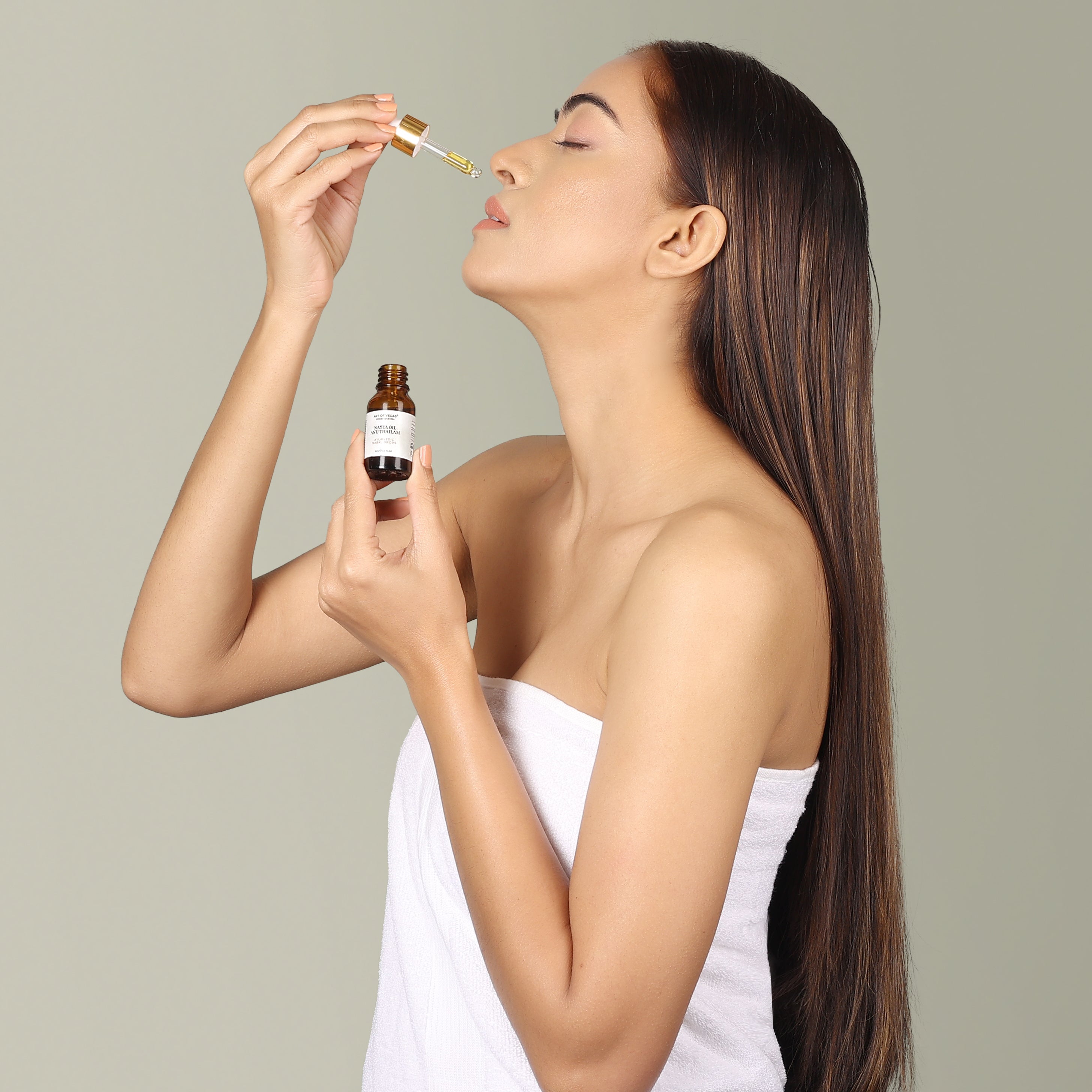
Nasya. Daily nasal oil practice — applying 2–5 drops of classical Nasya Tailam to each nostril in the morning — is referenced in classical texts for its effect on the sense organs and the tissues of the head and face. The classical understanding is that the nasal passages are the gateway to the head (Nasam hi Shirasodwaram), and that keeping them properly nourished supports the vitality of everything above the shoulders, including the facial skin. The Nasya guide covers this practice fully.
Seasonal adjustment. Ritucharya — adapting practice and diet to each season — is described in classical texts as essential to preventing the accumulation of Dosha-driven tissue damage over time. Skin aging accelerates when the body is repeatedly exposed to seasonal extremes without the counterbalancing practices that classical Ayurveda recommends.
Dosha-Specific Considerations
Vata-type aging (dry, fine lines, thin skin, loss of elasticity): Deeply nourishing Mukha Tailams — Kumkumadi as the primary classical preparation. Strong emphasis on daily Abhyanga. Ojas cultivation through warm, consistent, nourishing practices. The Vata guide covers the full constitutional picture.
Pitta-type aging (inflammation, hyperpigmentation, reactivity, redness): Eladi Tailam more appropriate than Kumkumadi in most cases. Kansa massage for its natural Pitta-drawing effect. Avoid highly warming preparations in summer or periods of Pitta elevation. The Pitta guide covers Pitta skin patterns in detail.
Kapha-type aging (congestion, dullness, enlarged pores, loss of tone): Stimulating practices — Garshana dry brushing, Ubtan, Kansa for its lymphatic-drainage emphasis — are more relevant than heavy oleation. Lighter face preparations in smaller quantities. The Kapha guide covers Kapha skin patterns.
A Practical Starting Point
For someone building a classical Ayurvedic approach to facial skin from the beginning, a useful sequence:
Begin with a classical Mukha Tailam appropriate to constitution — Kumkumadi for Vata-type or general aging patterns, Eladi for Pitta-reactive patterns. Applied in small quantities morning and/or evening after cleansing, massaged gently into the skin with light circular movements.
Add a Kansa facial wand, used over the face oil 3–5 times per week following the classical marma sequence. 5–10 minutes.
Integrate daily Nasya as part of the morning Dinacharya. Under 5 minutes, with significant cumulative effect on head and facial tissue vitality.
Extend to daily Abhyanga for the body — the internal tissue nourishment that determines skin condition over time, and without which topical preparations work only at the surface.
For a personalised classical assessment of which preparations and practices suit your constitution, an Ayurvedic consultation with one of our AYUSH-certified Ayurvedic doctors provides specific guidance drawn from a full classical evaluation.
This guide presents traditional Ayurvedic knowledge for general education. Preparations described are for external use and general wellbeing as part of a daily self-care routine. They are not medicines and are not intended to diagnose, treat, cure or prevent any disease.


