



Abhyanga: The Complete Classical Guide to Ayurvedic Oil Massage
Of all the practices described in the classical Ayurvedic texts, Abhyanga (uhb-yahn-gah) — the daily application of warm oil to the body — holds a unique position: it is simultaneously one of the most consistently prescribed practices across every major classical text and one of the simplest to perform at home. The Charaka Samhita, Ashtanga Hridayam and Sushruta Samhita all describe Abhyanga as a foundational component of Dinacharya (daily routine) — not as an occasional indulgence or a special treatment, but as a daily non-negotiable for the maintenance of health.
This guide covers the complete classical basis for Abhyanga, the step-by-step technique as described in the classical texts and adapted for home practice, oil selection by constitution and condition, and how to integrate the practice into a sustainable daily or weekly routine. Art of Vedas offers a complete range of classical and Dosha-specific oils for Abhyanga in the Body Rituals (Abhyanga) collection, the Abhyanga Oils collection and the Ayurvedic Thailams collection.
What the Classical Texts Actually Say About Abhyanga
The Charaka Samhita, Sutrasthana Chapter 5, contains one of the most direct and detailed classical prescriptions for Abhyanga. The text states: "Abhyangam achareth nityam" — one should perform oil massage daily. It then lists the specific benefits that daily Abhyanga provides, which are worth examining individually because they reflect the full classical understanding of what the practice achieves:
Jaravyapaha — slows the aging process. The classical explanation is that regular oil application to the skin and channels prevents the progressive drying and depletion of the Dhatus (body tissues) that underlies classical Ayurvedic aging theory. Vata — the dry, mobile, depleting Dosha — is the primary driver of aging in the classical model, and Abhyanga with warming, unctuous oil directly counters this process.
Shramahara — relieves fatigue and exhaustion. The Snigdha (unctuous) and warm qualities of the oil replenish the Rasa and Rakta Dhatus (plasma and blood) that become depleted through exertion, restoring a sense of physical and mental freshness.
Vatahara — pacifies Vata Dosha. This is the most directly pharmacological of the listed benefits and the one that underlies most of the others. Vata's qualities (dry, cold, rough, light, mobile) are countered by oil's qualities (unctuous, warm, heavy, stable), so regular oil application is the most direct and sustained approach to managing Vata in the classical system.
Drishtiprasadakara — improves vision and sensory clarity. As described in the Nasya context, the channels of the sensory organs are connected through the head, and the classical texts describe how nourishment delivered through the skin channels reaches and supports the eyes and other sensory organs over time.
Pushti and Ayu — nourishes the body and supports longevity. The Charaka Samhita describes how oil penetrates through the seven layers of skin (Sapta Twak) and progressively enters the seven Dhatus over days of regular practice, providing a sustained nourishment of the entire body from the outside in.
Svapnasukhakara — promotes deep, restful sleep. Evening or late-afternoon Abhyanga is specifically described as supporting sleep quality — the grounding, warming and Vata-pacifying action of the practice directly addresses the mental restlessness and physical tension that the classical texts identify as the primary barriers to deep sleep.
Twakdardhakarana — firms and strengthens the skin. The sustained nourishment of the skin layers through regular oil application is described as producing a strengthening and toning effect on the Twak (skin) — reflected in improved texture, resilience and tone over weeks and months of consistent practice.
The Ashtanga Hridayam, Sutrasthana Chapter 2, adds to this classical description by noting that the benefits of Abhyanga are particularly significant for the head, ears and feet — the three areas the text specifies as deserving special attention. Daily application of oil to these three areas, even when a full-body routine is not possible, is described as delivering a substantial portion of the complete benefit.
The Pharmacological Basis: How Oil Enters the Body
The classical Ayurvedic understanding of how Abhyanga works is built on the concept of Srotas — the channel network that permeates every tissue. The skin is not understood merely as a physical barrier but as a living channel system through which substances applied externally can progressively enter deeper tissues. Oil, with its Sukshma (subtle, penetrating) and Snigdha (unctuous) properties, is described as one of the few substances capable of penetrating through the seven layers of skin and into the Dhatu channels beyond.
The classical texts describe a seven-day timeline for progressive oil penetration: after the first day of application, the oil nourishes the surface skin; by day three, it has reached the deep dermis; by day seven of continuous daily practice, it has begun to reach the deeper Dhatus. This is the classical explanation for why Abhyanga benefits become progressively deeper and more sustained with consistent practice — and why a single application, while beneficial, does not deliver the full classical benefit that the texts describe.
The Step-by-Step Classical Abhyanga Technique
The following technique follows the classical sequence described in the Ashtanga Hridayam and adapted for self-practice at home. Allow 20 to 45 minutes for the complete practice, including the post-application rest period.
1. Prepare your oil
Warm your chosen Abhyanga oil by placing the bottle in a bowl of hot water for 5 minutes. The classical texts consistently specify warm oil — cold oil does not penetrate the channels effectively and the experience lacks the calming, grounding quality that the warm oil application provides. Select your oil according to your constitution and the season (see the oil selection guide below). For a daily Abhyanga oil by Dosha, the Abhyanga Oils collection and Dosha Massage Oil collection provide pre-blended formulations designed for each constitution.
2. Begin with the scalp (optional)
The Ashtanga Hridayam describes Shiro Abhyanga (head massage) as the first step of the classical sequence. Apply a small amount of oil to the scalp and massage firmly with the fingertips and palms — circular movements across the entire scalp, with particular attention to the crown (Adhipati Marma point) and the back of the head (Krikatika Marma). If you prefer to keep your hair dry, skip this step and begin with the ears.
3. Ears and face
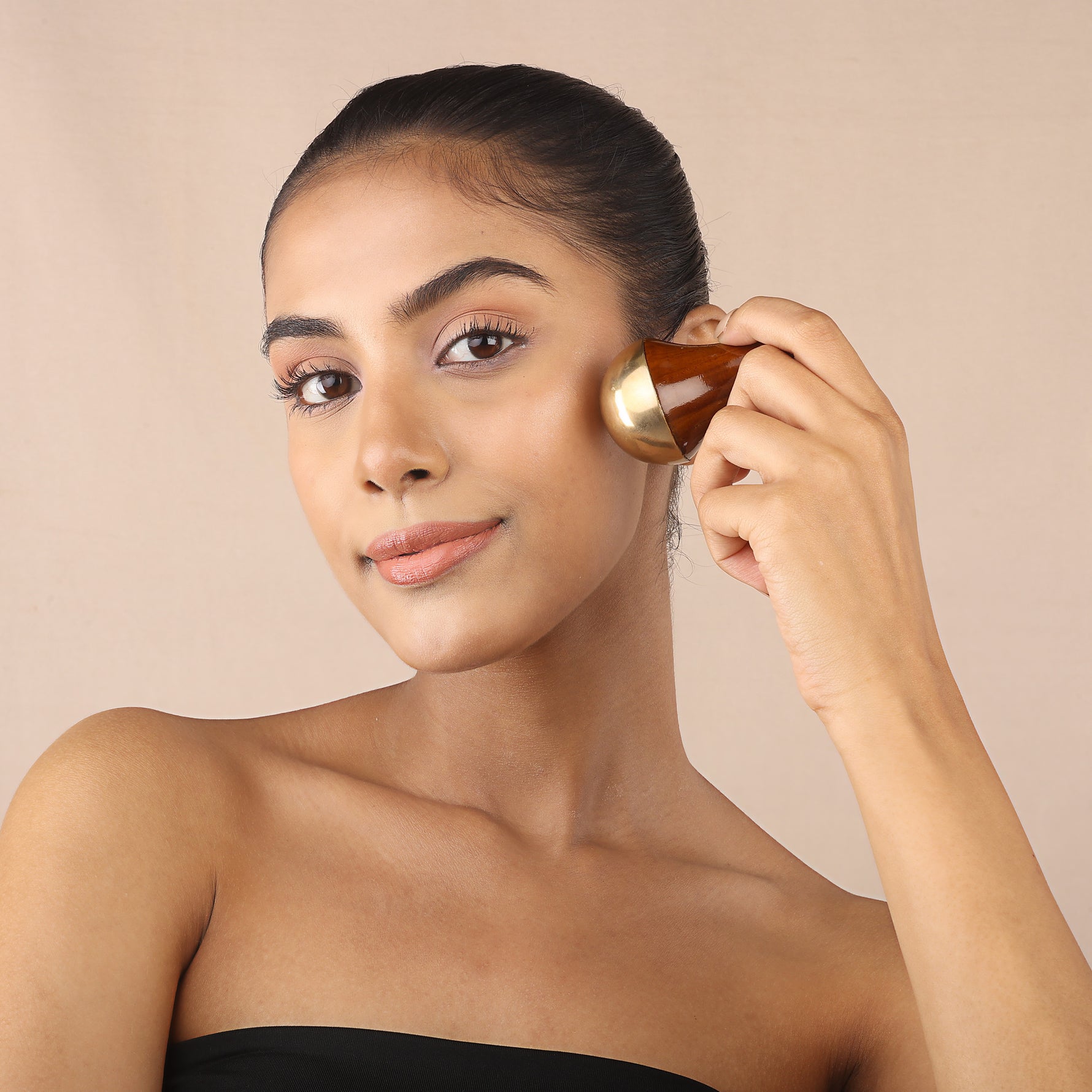
Apply a few drops of oil to the outer ears — the classical texts describe the ears as one of the three areas deserving special daily attention. For the face, either apply oil with the fingertips using gentle outward strokes, or use a Kansa Wand for the classical Mukha Abhyanga (facial massage) technique described in the Kansa Wand guide.
4. Neck and shoulders
Apply oil and massage with circular movements on the shoulder joints and long sweeping strokes along the neck and upper back. The cervical region accumulates Vata tension readily — sustained strokes here, working from the base of the skull down to the shoulder blades, are described in the classical texts as supporting the free movement of Prana Vata through the upper body channels.
5. Arms
Use long strokes from shoulder to wrist on the arm bones (following the Asthi, or bone channels) and circular strokes on the elbow and wrist joints. The classical rule for stroke direction is clear: linear strokes on long bones, circular strokes on joints. This pattern is followed consistently throughout the body.
6. Chest and abdomen
Apply oil to the chest with broad circular movements. On the abdomen, use clockwise circular strokes — following the direction of the intestinal movement described in the classical texts. The navel (Nabhi) is a significant Marma point and receives gentle, centred circular massage. Avoid vigorous pressure on the abdomen.
7. Back
Apply oil with long strokes along the spine (without pressing on the vertebrae) and circular strokes on the sacral area. For self-practice, the back is the most difficult area to reach fully — doing what is accessible and focusing on the lower back and sacrum provides significant Vata-pacifying benefit even if the upper back cannot be fully reached.
8. Legs and feet
Long strokes from hip to ankle on the femur and tibia, circular strokes on the knee and ankle joints. The classical texts specify special attention for the feet — both the soles and each individual toe. The feet contain multiple important Marma (vital energy) points and are the area the Ashtanga Hridayam specifically lists for daily oil application. Thorough foot massage with warm oil is described as supporting eye health, sleep quality and general Vata balance through the foot channel connections — a relationship also explored in the Kansa Vatki foot massage guide.
9. Rest period
After applying oil to the entire body, sit or lie quietly for a minimum of 20 minutes — ideally 30 to 45 minutes. The classical texts are clear that the post-application rest is not optional: it is during this period that the oil penetrates through the skin layers into the deeper channels. Covering the body with an old towel or wearing old clothing retains warmth and supports the penetration process. Some practitioners extend the rest period to one hour for the most complete classical practice.
10. Bathe in warm water
Bathe in warm (not hot) water after the rest period. Warm water opens the pores and supports the final stage of oil absorption while removing surface excess. Hot water is specifically advised against in the classical texts as it can strip the oil from the surface before it has fully penetrated — counterproductive to the entire practice. Do not use strong soap or shower gel on the oiled skin areas; warm water alone is sufficient.
Oil Selection by Constitution and Condition
Choosing the right oil is the single most important variable in an Abhyanga practice. The classical texts provide clear guidance for selection based on constitution (Prakriti) and current imbalance (Vikriti).
For Vata constitution or Vata imbalance (cold, dry, light, restless, anxious): The classical first recommendation is a warming, nourishing, Vata-pacifying oil. Dhanwantharam Thailam is the foundational classical Vata oil — appropriate for general daily Abhyanga and the first classical recommendation for most Vata presentations. The pre-blended Vata Dosha Massage Oil provides an accessible entry point for those new to classical oils. For deeper Vata-muscular depletion, Mahamasha Thailam provides heavy, sustained nourishment. For broad diffuse Vata across the whole body, Mahanarayana Thailam is the classical Sarva Vata Hara (all-Vata) formulation.
For Pitta constitution or Pitta imbalance (hot, sharp, inflamed, irritable): A cooling, Pitta-pacifying oil is classically indicated. Pinda Thailam is the primary cooling classical oil — specific for Pitta-type joint conditions and skin presentations with heat. Ksheerabala Thailam is cooling and neural — suited to Pitta-Vata presentations with a nervous system dimension. The pre-blended Pitta Dosha Massage Oil is formulated for Pitta constitutions and provides a reliable daily option. The Abhyanga Oils collection and Dosha Massage Oil collection together provide the full Pitta range.
For Kapha constitution or Kapha imbalance (heavy, slow, cool, damp, congested): Lighter, stimulating oils with a more vigorous application technique are classically appropriate. Kapha benefits less from heavy, unctuous oils and more from the stimulating mechanical action of firm Abhyanga. The Tri Dosha Massage Oil provides a balanced, lighter formulation appropriate for Kapha types. The technique for Kapha Abhyanga is described as more vigorous and brisk than for Vata — counter-stimulating rather than calming.
For mixed constitutions or those unsure of their Dosha: The Tri Dosha Massage Oil is the reliable choice — formulated to be appropriate across all three constitutions and all seasons. If you are uncertain of your constitution, the Art of Vedas Dosha assessment provides a structured framework for identifying your type and selecting the most appropriate oil. The guide to comparing classical Ayurvedic massage oils provides a complete oil-by-oil framework for those who want to select from the classical formulations.
Timing: When to Perform Abhyanga
The classical texts describe morning Abhyanga — before bathing, during the Vata time of early morning (approximately 6 to 10am) — as the ideal timing for the daily practice. This timing aligns with the natural Vata-dominant phase of the morning cycle and with the Dinacharya sequence of practices that begins the classical day.
Evening Abhyanga — performed 2 to 3 hours before sleep — is specifically described in the Ashtanga Hridayam for its Svapnasukhakara (sleep-supporting) benefit. The grounding and calming action of warm oil application before sleep is among the most consistently effective uses of Abhyanga for those dealing with restless sleep, night-time mental activity or Vata-type insomnia. Evening Abhyanga typically focuses on the feet, scalp and lower back — the three areas the classical texts most associate with sleep-supportive benefit — even when a full-body routine is not possible.
Frequency: How Often Is Enough?
The Charaka Samhita prescribes daily Abhyanga. The practical reality for most people working full schedules is that daily practice is sustainable only if the routine is kept to 20 to 30 minutes including the rest period — achievable before a morning shower. For those who cannot manage daily practice, the classical texts also describe significant benefit from three-times-weekly practice, and even once-weekly Abhyanga provides meaningful Vata-pacifying and skin-nourishing benefit.
Art of Vedas recommends building the practice incrementally: begin with once or twice weekly, develop a consistent technique and oil selection, then increase frequency as the routine becomes established. A 20-minute weekly Abhyanga practiced consistently for three months will produce more classical benefit than an elaborate 60-minute session performed occasionally. The complete Abhyanga oil range is available at Art of Vedas in the Body Rituals collection.
Seasonal Abhyanga: Adjusting the Practice Through the Year
The Ashtanga Hridayam describes how Abhyanga practice should adjust with the seasons — both in the choice of oil and in the post-application approach. In winter (Hemanta and Shishira), when Vata and cold are most pronounced, the classical texts recommend the most intensive Abhyanga practice with the heaviest, most warming oils and the longest rest period. In summer (Grishma), a cooling oil (Pinda Thailam, Ksheerabala, or the Pitta Dosha Massage Oil) is appropriate and the duration can be reduced. In the monsoon transition (Varsha), when Vata is classically most unstable, daily Abhyanga with a warm classical oil is particularly recommended as a stabilising daily anchor.
Frequently Asked Questions
How is Abhyanga different from ordinary massage?
Ordinary massage focuses primarily on the musculature — working with muscular tension, trigger points and physical recovery. Classical Abhyanga works primarily with the skin-channel network (Twak Srotas) and the Dosha-pacifying action of the oil — the physical strokes serve to distribute and drive the oil into the skin channels rather than primarily address the muscles. The direction, pressure and sequence of strokes all follow the classical channel-direction principles of the Srotas network, not purely the biomechanical logic of muscle therapy. The oil itself is pharmacologically active — different oils produce different therapeutic effects regardless of technique.
Can I do Abhyanga during menstruation?
The classical texts describe Abhyanga as generally appropriate throughout the cycle, with some schools advising a lighter technique and avoiding vigorous abdominal massage during the first two days. Gentle Abhyanga focusing on the lower back, feet and legs is described as supportive during this period. Individual constitution plays a role — those with significant Vata-type symptoms (cramping, irregularity, cold) during their cycle particularly benefit from warm-oil application to the lower back and abdomen.
Should Abhyanga oil be washed off completely after the rest period?
The classical texts describe bathing in warm water after the rest period — not vigorous scrubbing to remove all oil. A thin film of oil remaining on the skin after bathing is normal and beneficial. The skin should feel smooth and slightly nourished after bathing, not squeaky-clean. Heavy soap or shower gel strips the oil from the surface and reduces the sustained benefit of the practice.
Can I do Abhyanga while pregnant?
Abhyanga is described in the classical texts as highly beneficial during pregnancy — supporting tissue nourishment, reducing Vata aggravation and supporting the developing foetus. The Ashtanga Hridayam contains specific descriptions of pregnancy-appropriate oils and techniques. For pregnancy Abhyanga, the oil selection and technique should be guided by a qualified Ayurvedic practitioner — not all classical oils are appropriate in all trimesters, and the technique adjusts to avoid pressure on the abdomen in later pregnancy. The Postpartum Recovery collection covers the classical postpartum Abhyanga oils.
Is it possible to do too much Abhyanga?
The Charaka Samhita describes Atiyoga (excess) of Abhyanga as producing a sense of heaviness and sluggishness — Kapha-like symptoms from too much oil and too much Snigdha (unctuous) quality. For Kapha constitutions or during Kapha seasons, very frequent heavy-oil Abhyanga can occasionally aggravate Kapha heaviness. Daily practice with a lighter oil and brisk technique is generally better for Kapha than infrequent practice with heavy oil. For Vata and Pitta constitutions, daily practice with an appropriately selected oil from the Abhyanga Oils collection is described as consistently beneficial without risk of excess in the classical texts.
How do I know which Abhyanga oil to choose?
The most practical starting points: if you tend toward dryness, cold, anxiety and restlessness — a Vata-type oil such as Dhanwantharam Thailam or the Vata Dosha Massage Oil. If you tend toward heat, inflammation and intensity — the Pitta Dosha Massage Oil or Pinda Thailam. If you are unsure or want a single oil for all seasons — the Tri Dosha Massage Oil. The classical oil comparison guide and the Dosha assessment provide more structured guidance for choosing between the classical formulations.
Abhyanga is a traditional Ayurvedic self-care practice. The oils used in Abhyanga are food-grade and traditionally prepared Ayurvedic formulations. They are not intended to diagnose, treat, cure or prevent any disease. For chronic health conditions, pregnancy or post-surgical recovery, consult a qualified Ayurvedic practitioner before beginning an oil massage practice.


